Skip to content

What Is Xtream Codes? The 3 Fields That Log You In
What is Xtream Codes? It is a login system, not an app and not a TV service. Instead of pasting a long playlist link, you give your player three things — a server URL, a username and a password — and the provider’s server hands back your live channels, movies, series and TV guide in one organized bundle. The name comes from a control panel that shut down in 2019; what survived is the login format every serious player now speaks.
That short answer covers most of what people want. The rest of this page covers the part nobody explains: what each field actually contains, what the server sends back the moment you sign in, why your account’s expiry date and connection count show up inside the app, and why a piece of software that no longer exists still has its name on your login screen.
If you are trying to decide which format to use rather than understand this one, read M3U vs Xtream Codes instead. If your login is already failing, skip to Xtream request failed / failed to connect. This page is the “what is this thing” page.
Xtream Codes is a protocol, not a product you buy
Here is the mental model that makes everything else click. Xtream Codes is a conversation format — an agreed way for a player app to ask a provider’s server questions and get answers back in a structure the app understands. Developers call that an API. Nobody sells you Xtream Codes. Your provider runs a server that speaks it, your player knows how to speak it, and the three credentials are what proves you are allowed to ask.
You can see this for yourself without any special tools. The endpoint your player talks to is a file on the provider’s server literally named player_api.php. Your app sends the username and password to it, and it replies with a block of structured data: your account status, the channel categories, the live list, the movie list, the series list. That is the entire mechanism. There is no magic in it, which is exactly why so many different apps support it.
Compare that with the older approach. A plain playlist file is a static text document — a snapshot someone generated at a moment in time, in the M3U format that has been around since the WinPlay3 days and whose extended version later became the basis for Apple’s HLS spec, RFC 8216. It works, but it is a photograph. An Xtream Codes login is a phone line. Ask again tomorrow and you get tomorrow’s answer.
The three fields, decoded
Every Xtream Codes login screen asks for the same three things, and every one of them trips somebody up.
1. The server URL (also called “portal” or “host”)
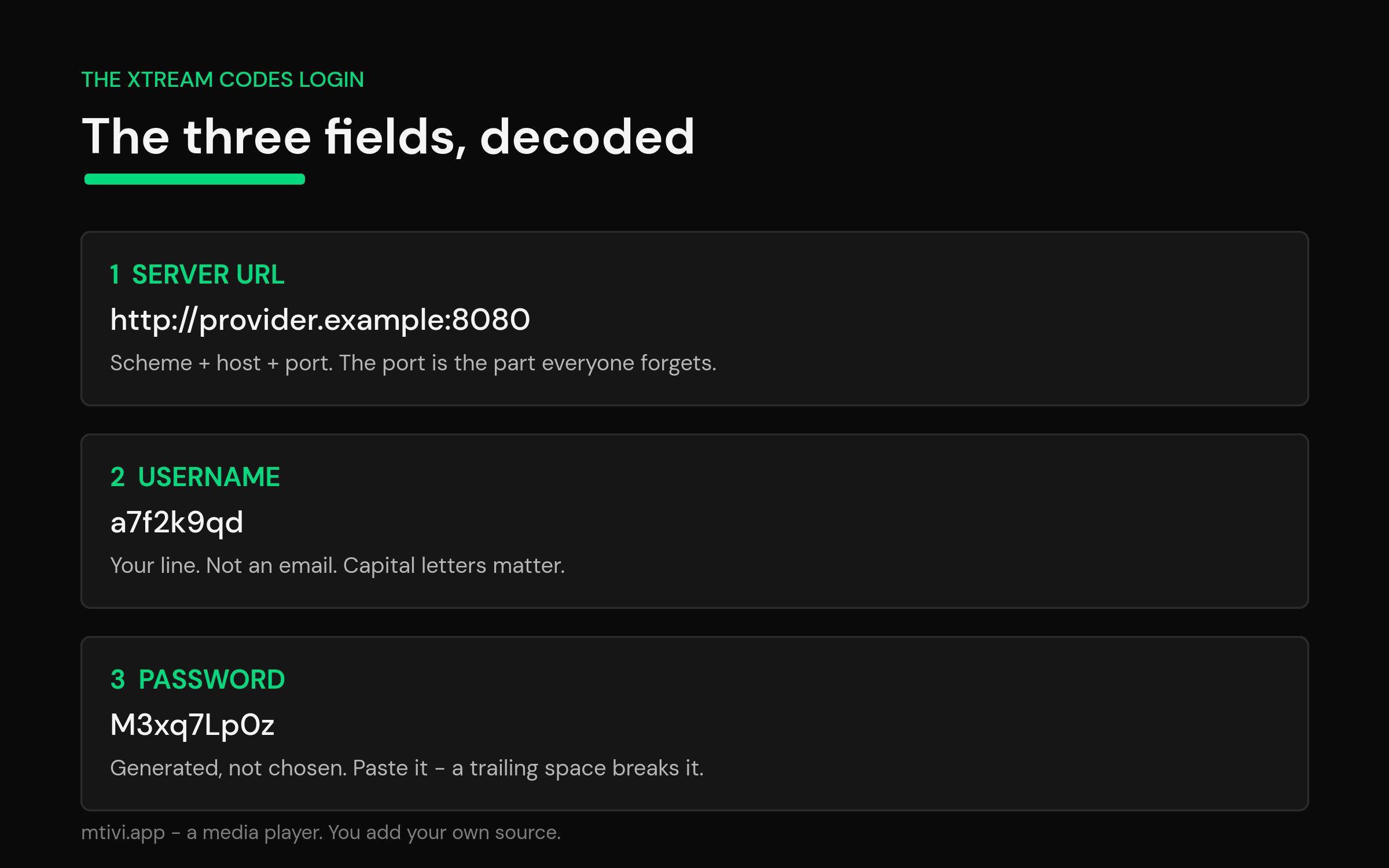
This is not just a domain. It is three parts glued together: the scheme, the host, and usually a port. Something like http://provider.example:8080. The port is the number after the colon, and it is the single most-skipped part of an Xtream login. Providers hand out :8080, :80, :25461 and plenty of others. Leave it off and your player quietly tries the default port for the scheme, gets nothing, and tells you the server is unreachable.
The scheme matters too. http:// and https:// are different doors on the same building, and a server listening on one will not answer on the other. If your provider’s email says http, type http, even though every instinct you have says to add the s.
One more trap: do not paste the whole playlist link into the server URL box. If what you were sent ends in get.php?username=...&password=..., that is a playlist link, not a portal. The portal is only the part before the first single slash after the host.
2. The username
In provider-speak, your username plus password is called a line. One line is one subscription. It is normally a short random string — not an email address, not a name you chose — and it is case-sensitive. User7742 and user7742 are two different accounts as far as the server is concerned, and only one of them exists.
3. The password
Same rules, more consequences. Passwords on these systems are generated, not chosen, and they are often long enough that a single mistyped character is invisible. Copy and paste from your provider’s email rather than typing on a TV remote. The most common cause of a rejected Xtream login is not an expired account; it is a trailing space that came along for the ride when someone highlighted the text.
| Field | What it looks like | The mistake people make |
|---|---|---|
| Server URL / portal | http://provider.example:8080 | Dropping the port, or swapping http for https |
| Username | a7f2k9qd | Assuming it is an email; ignoring capital letters |
| Password | M3xq7Lp0z | Typing it by hand; pasting a trailing space |
| Playlist link (different thing) | http://provider.example:8080/get.php?... | Pasting the whole thing into the portal box |
What your player actually receives when you sign in
The moment those three fields are accepted, the server replies with far more than a channel list. This is the part that explains a lot of otherwise-baffling app behavior.
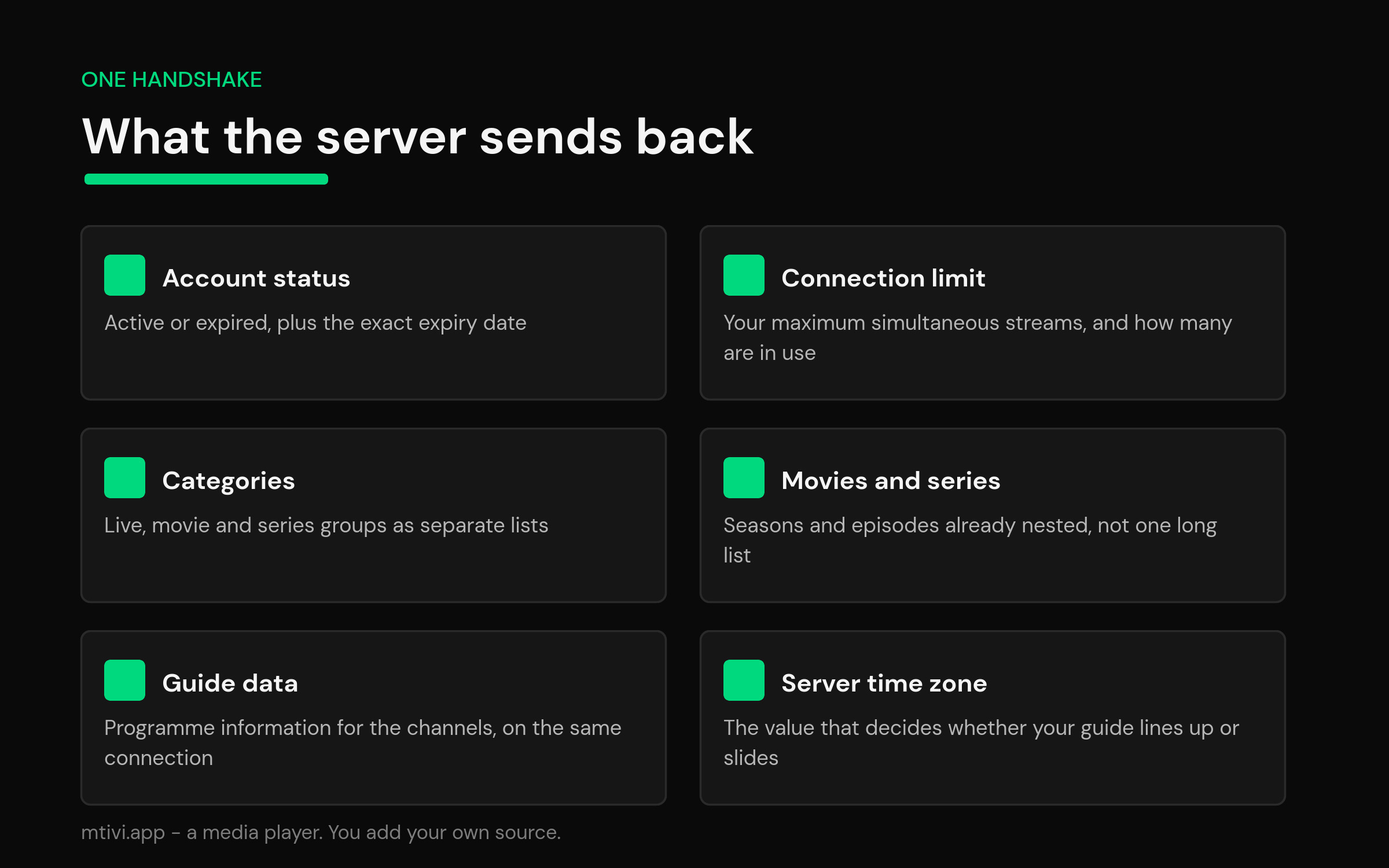
- Account status and expiry date. Your player is told, in plain data, whether the line is active and what date it runs out. That is why a decent app can show you “expires in 12 days” without you logging in anywhere else.
- Your connection limit and how many are in use. The server reports both the maximum simultaneous streams your plan allows and how many are currently active. A “max connections reached” message is the server counting, not your app guessing.
- Categories, then contents. Live channel groups, movie groups and series groups arrive as their own lists, which is why an Xtream login lands with a tidy structure instead of one endless scroll.
- Movies and series as separate sections. Series arrive with seasons and episodes already nested, rather than as thousands of loose entries you have to decode from channel names.
- Guide data. Program information for the channels comes down the same connection, so a full EPG usually populates without you supplying a separate XMLTV link.
- The server’s own time zone. This one is easy to miss and matters enormously. The server tells your player what time zone it is in, and if that value is wrong or if your device disagrees, your guide slides by hours. If that sounds familiar, it is the root cause behind an EPG that is off by hours.
Because all of that arrives in one handshake, an Xtream login also refreshes cleanly. Nothing has to be re-downloaded as a file and re-parsed from scratch, which is a large part of why big lists behave better this way — see loading very large playlists without lag for what that looks like in practice.
Your Xtream login and your M3U link are the same account
This confuses almost everyone at some point. Your provider usually gives you both a portal login and a long playlist URL, and they look like completely different products. They are not. Look at the playlist link and you will see your username and password sitting inside it as query parameters. Same line, same expiry, same connection limit — two doors into one account.
Practical consequence: switching from a playlist link to an Xtream login does not give you a second subscription, and it will not free up a connection slot. It changes how your player asks, not what you are entitled to. If juggling slots across TVs is your actual problem, the useful lever is not the login format — it is recording without burning your live connection.
Where the name came from, and why it outlived the company
Xtream Codes began as commercial panel software, sold to operators who wanted to run and bill a subscriber base. It was registered as a company in Bulgaria and, by its own account, had been in the software business since 2015. In September 2019 Italy’s Guardia di Finanza targeted the platform in a large multi-country operation, servers were seized, and the panel effectively stopped existing overnight.
The legal story did not end there, and the ending is not the one most blog posts imply. In August 2021 the Court of Appeals of Naples found no evidence that Xtream Codes Ltd had acted unlawfully between 2015 and its closure, a prosecutor’s appeal to Italy’s Supreme Court of Cassation was dismissed, and the seized assets were ordered returned. The software was ruled lawful; what individual operators did with it was a separate question.
Meanwhile the code had already scattered. Forks and rewrites picked up where the original left off, and because they all kept the same request format, the phrase “Xtream Codes” stopped meaning a company and started meaning a login standard. That is the useful takeaway: when your player offers “Login with Xtream Codes API”, it is not connecting you to anything called Xtream Codes. It is telling you which dialect it will use to talk to whichever server your provider happens to run.
What Xtream Codes is not
Four corrections that clear up most of the confusion:
- It is not a provider. It supplies no channels, movies or series. It is a way of asking a server for whatever that server already holds.
- It is not an app. You do not download Xtream Codes. You download a player, and the player supports the format.
- It is not a subscription. Nobody sells “an Xtream Codes account”. Your provider sells you a line; the format is how your app reads it.
- It is not a quality setting. Switching to an Xtream login does not sharpen the picture or stop buffering. The stream is the same stream; only the way it is catalogd changes.
Worth stating plainly, since this is where readers usually ask about IPTV generally: the format is neutral technology. What determines whether any given setup is legitimate is the licensing status of what the server is delivering, not the login screen in front of it. Our take on that sits in is using an IPTV player legal.
The security part nobody mentions
Your username and password travel as ordinary text in the request. On an http:// portal, they are not encrypted in transit. Two things follow from that.
First, never post a screenshot of your login screen, and be careful with playlist links — because the credentials are embedded in the URL, sharing the link is sharing the password. People post these in help threads constantly without realizing they have just handed out their subscription, and the giveaway is a sudden run of “max connections reached” errors.
Second, if your provider offers an https:// portal, prefer it. It will not make an unlicensed service legitimate, but it does stop your credentials being readable by anything sitting between you and the server.
Using an Xtream Codes login in mtivi
mtivi accepts an Xtream Codes login the same way it accepts a playlist file or link: portal, username, password, done. What you get afterwards is the reason to bother.
Your categories arrive already separated into live, movies and series. The guide fills in on its own, and if the server’s time zone is telling fibs you can correct it rather than living with a guide that is three hours out — the practical steps are in our EPG setup guide. Add the line once and cloud sync carries it, plus your favorites and layout, to your other screens without you retyping a portal URL on a remote control ever again. And when the movies and series that arrive are in a language you do not read, subtitle translation handles that side of it.
mtivi is free to start and needs no account to try. What it will never do is hand you a portal URL — that comes from you.
Related guides
- M3U vs Xtream Codes: which IPTV format should you use?
- Xtream request failed / failed to connect: how to fix it
- What is an IPTV player? A clear guide for 2026
- What is EPG in IPTV? The TV guide, explained
- IPTV EPG wrong time? How to fix a guide that is off by hours
Frequently asked questions about Xtream Codes
Is Xtream Codes an app I need to download?
No. There is nothing to install called Xtream Codes. It is a login format that player apps support. You install a player, choose the Xtream Codes login option, and enter the portal URL, username and password your provider gave you.
Does mtivi provide the channels I see after logging in?
No. mtivi is a media player. We don’t provide, sell, or include any channels, movies, series, or playlists. You add your own source, and everything that appears after you log in comes from that source’s server, not from us.
What is the difference between an Xtream Codes login and an M3U link?
An M3U link downloads a static playlist file that your player then reads. An Xtream Codes login opens a live conversation with the server, which returns categories, movies, series, guide data and your account status separately. Both usually point at the same account. There is a full side-by-side in our M3U vs Xtream Codes comparison.
Do I need the port number in the server URL?
Almost always, yes. If your provider’s details include something like :8080 or :25461, that number is part of the address and leaving it out will stop the connection. Only omit it if your provider explicitly gave you a bare domain with no port.
Should I use http or https for the portal?
Use exactly what your provider specified. They are separate doors and a server listening on one will not answer on the other. If both are offered, https is the better choice because it encrypts your credentials in transit.
Why does my player show an expiry date I never entered?
Because the server tells it. Part of the reply to an Xtream Codes login is your account status, including the expiry date and your connection limit. The app is displaying data the server sent, not a guess.
Does switching to an Xtream Codes login give me more connections?
No. Your connection limit belongs to the line your provider sold you, not to the login format. Both the portal login and the playlist link draw on the same account and the same limit.
Is Xtream Codes still maintained after the 2019 shutdown?
The original company’s panel was dismantled in September 2019 and was not revived by its owners. Various forks and independent rewrites now run in its place, and they kept the same request format — which is why the name persists as a login standard rather than as a product.
Was Xtream Codes ruled illegal?
No. In August 2021 the Court of Appeals of Naples found no evidence that the company acted unlawfully between 2015 and its 2019 closure, an appeal to Italy’s Supreme Court of Cassation was dismissed, and the seized assets were returned. The panel software itself was held to be lawful.
Is it safe to share my portal URL in a support thread?
No. Treat it like a password. On a playlist link your username and password are visible inside the URL itself, so sharing the link hands over your subscription. If you have already posted one, ask your provider to reset the line.
Why do my movies and series look better organized with an Xtream login?
Because the server sends them as their own catalogs with categories, and series arrive with seasons and episodes already grouped. A plain playlist file usually delivers everything as one long list of entries your player has to interpret from the channel names.
My Xtream Codes login worked yesterday and fails today. What changed?
Usually one of four things: the line expired, the provider changed the portal address, you are over your connection limit because a device did not fully close, or your network is blocking the host. Our guide to “Xtream request failed / failed to connect” walks through how to tell which one it is.
Can I use one Xtream Codes login on several devices?
Only up to the number of simultaneous connections your plan allows. Adding the same login to more devices is fine; watching on more of them at once than your limit permits is what triggers the error. Fully exiting the player on a device releases its slot.
Does an Xtream Codes login improve streaming quality?
No. The video itself is unchanged. What improves is organization, guide data and refresh behavior. If you are buffering, the cause is bandwidth, the server or your device, not the login format.