Skip to content
Is Using an IPTV Player Legal? The 2026 Answer
Last updated: July 29, 2026
Yes — using an IPTV player is legal. A player is just software: an empty app that opens and plays the playlist you give it, the same way a video player opens video files. The law doesn’t care which app you press play in. It cares about your source — whether the channels, movies, and series in your playlist are licensed for you to watch.
That one distinction — player versus source — settles most of the arguments you’ll find in forums. The rest of this guide covers what’s left: how to tell a licensed source from an unlicensed one, what the law in different regions actually targets, whether ordinary viewers face any risk, and the myths that refuse to die.
One note before we start: this is general information, not legal advice. Copyright law differs by country, and if you have a real legal question, put it to a lawyer in yours.
A player and a source are two different things
Every IPTV setup has two halves. The source is the playlist or subscription that contains the actual streams — usually an M3U or M3U8 link, or an Xtream Codes login, supplied by a provider. The player is the app that takes that source and turns it into something watchable: a channel list, a TV guide, playback controls, subtitles.
Install any IPTV player and open it before adding anything, and you’ll see the point immediately. There is nothing to watch. No channels, no movies, no series — just an empty interface asking for a playlist. It’s the same as installing VLC and expecting films to appear. The app is a tool, and tools are empty until you load them.
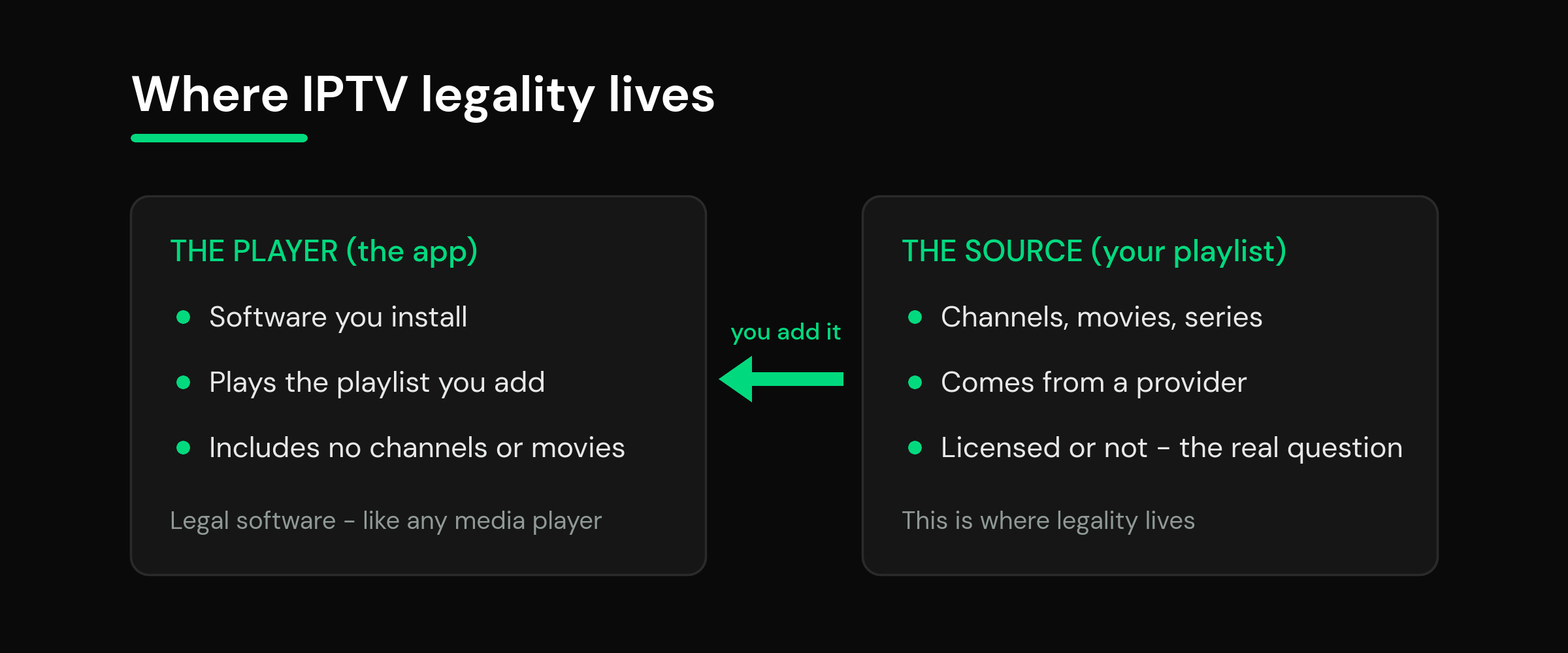
Where legality actually lives: the source, not the software
Copyright law regulates who may distribute and watch protected works. It says nothing about which app renders the video. So the legal question is never “is this player legal?” — it’s “does the service behind my playlist have the rights to stream these channels, movies, and series to me?”
If the answer is yes — a broadcaster’s own stream, a properly licensed provider, free-to-air channels, your own recordings or personal media files — then pressing play in any player is fine. If the answer is no, switching apps changes nothing. A stream doesn’t become licensed because you opened it in a prettier player, and it doesn’t become unlawful because you opened it in a different one. The app is neutral either way.
Licensed or not: the signals that matter
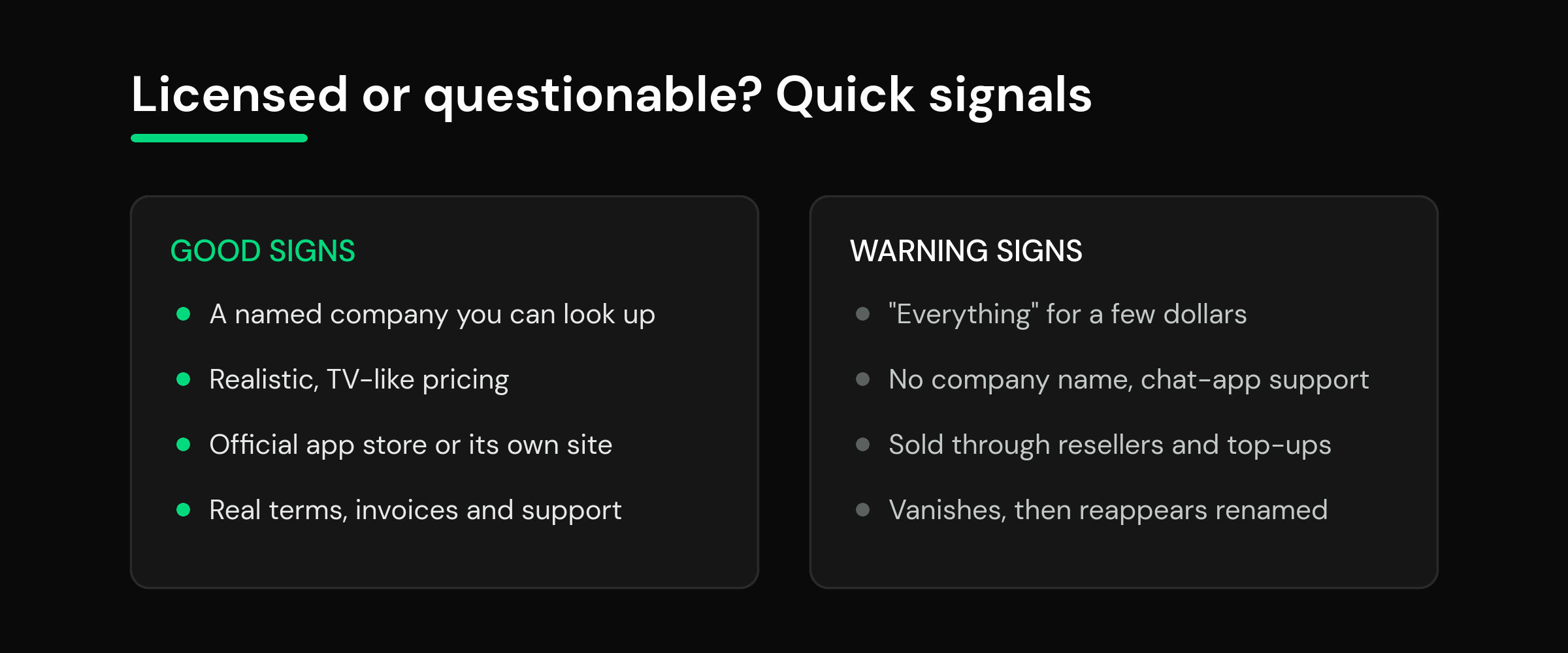
Unlicensed services rarely announce themselves, but once you’ve looked at a few, the pattern is hard to miss:
| Signal | Licensed source | Questionable source |
|---|---|---|
| Price vs. offering | Priced like TV — real money for real rights | “Every channel on earth” for a few dollars a month |
| Who runs it | A named company you can look up, with an address and support | No company name; contact only through chat apps |
| Where you get it | Official app stores or its own credible site | Resellers, “credit” top-ups, reposted links |
| Reliability | Stable, with a status page and refunds | Vanishes, then reappears under a new name |
| Paper trail | Invoices, terms, licensing information | None |
No single row proves anything on its own. Together they’re usually conclusive. Licensing a catalog of thousands of premium channels costs broadcasters and studios enormous sums — if a subscription offers all of it for the price of a sandwich, somebody isn’t paying for those rights, and it isn’t the seller.
What the law actually targets
Details vary by country, but the direction is consistent everywhere: lawmakers and courts go after the people running and selling unlicensed services, not the software that plays video.
- United States: the Protecting Lawful Streaming Act (2020) made operating a commercial, unlicensed streaming service a felony. It was written to target operators and sellers; an ordinary viewer’s exposure is generally civil, not criminal.
- United Kingdom: the Digital Economy Act 2017 raised maximum sentences for online copyright infringement to ten years — again aimed squarely at distributors and sellers, and it has been used against people selling “fully loaded” streaming devices.
- European Union: the EU’s top court ruled back in 2017, in a case about preloaded media boxes, that streaming from a source you know is unlicensed is itself an infringement — the “temporary copy” defense doesn’t cover it.
Notice what’s missing from that list: any law against player software. A neutral player, on its own, infringes nothing — which is why media player apps of every kind ship openly on every platform and app store.
Can you get in trouble just for using an IPTV player?
For installing and using the app itself: no. We’re not aware of any jurisdiction where having a media player on your device is an offence — if it were, every phone ever sold would be a problem, since they all ship with one.
For what you stream through it: that depends on your source and your country, as covered above. Enforcement effort overwhelmingly lands on operators, resellers, and sellers of preloaded boxes rather than viewers, but “unlikely to be prosecuted” is not the same as “legal”, and in some regions knowingly watching unlicensed streams is itself infringement.
The practical risks of shady services are more mundane anyway: they take your money and disappear, streams die right when you sit down to watch live sports, and there’s nobody to complain to afterwards. Sticking to licensed sources solves the legal question and the reliability one at the same time.
Five myths worth clearing up
“A VPN makes it legal”
A VPN encrypts your traffic and hides your IP address. It’s a privacy tool — useful for lots of legitimate reasons — but it doesn’t license anything. An unlicensed stream watched over a VPN is still an unlicensed stream.
“The app was free, so the channels must be free”
The free thing is the software. A free player plays whatever source you add — it doesn’t come with channels, and no honest player claims otherwise.
“It came preloaded, so it must be fine”
Backwards, unfortunately. Devices and apps sold “fully loaded” with working streams are precisely what courts and trading-standards agencies have targeted for years. A clean player arrives empty. That difference is the whole point.
“I paid for it, so it must be licensed”
Paying a reseller doesn’t create broadcasting rights. Plenty of unlicensed services charge money — that’s the business model. What matters is whether the operator holds licenses, not whether you paid.
“Everyone uses it, so nobody cares”
Rights holders run coordinated shutdown operations every year, and services that looked untouchable have disappeared overnight — taking their customers’ prepaid months with them. Popularity is not protection.
Where mtivi stands
What mtivi does provide is the player half done properly: a full TV guide with catch-up and time-shift, recording that works even on single-connection plans, subtitle translation into 55+ languages on the Pro plan, Public/Kids/Private profiles with parental PIN locks, cloud sync across devices, and smooth performance with very large playlists (80,000+ channels). It runs today on Android phones and tablets, Android TV, Google TV, Fire TV, and Nvidia Shield, with more platforms coming. Download mtivi, open it, and you’ll see exactly what this guide described: a player with nothing to watch until you add your own playlist. That’s what legal software looks like.
Frequently asked questions
Is the IPTV player app itself legal?
Yes. A player is standard software, like any media player, and it contains no channels, movies, or series. Legality depends entirely on the source you add to it, not on the app.
How can I tell if an IPTV service is licensed?
Look for a named company you can verify, realistic TV-like pricing, presence in official app stores or on its own credible site, and real terms, invoices, and support. A catalog of “everything” for a few dollars a month is the clearest warning sign there is.
Can I get in trouble for watching unlicensed streams?
It depends on where you live. Enforcement focuses on operators and sellers, but in some regions – the EU notably – knowingly streaming from an unlicensed source is itself infringement. The safe and simple answer is to stick to licensed sources.
Does mtivi provide any channels, movies, or series?
No. mtivi is a media player. We don’t provide, sell, or include any channels, movies, series, or playlists. You add your own source, and the app plays it.
Do I need a VPN to use an IPTV player?
No. A player works fine without one. A VPN is a privacy choice, not a requirement – and it never changes whether a stream is licensed.
Is it legal to use an IPTV player with a paid subscription?
Yes. If your provider is licensed and you pay for it, using a player like mtivi to watch it is no different from using any media player with a legitimate source. The player is neutral; legality follows the source.
Are M3U and Xtream Codes links legal?
The format itself is just a way to list channels, so it is legal. Whether a specific link is legal depends entirely on whether the service behind it is licensed to distribute what it carries.
Can I be fined for using an IPTV player?
The player itself is not the issue; enforcement targets unlicensed services and, in some places, people knowingly accessing them. Using a player with a legitimate, paid source carries no such risk. Laws vary by country.
Is it legal to record from an IPTV player?
Recording content you are licensed to watch, for personal use, is generally treated like recording any TV you pay for. Redistributing recordings is where it becomes infringement. Check your local rules and your provider terms.
Does a VPN make unlicensed streams legal?
No. A VPN protects your privacy on the network, but it does not change the licensing status of a service. If a source is not legitimate, a VPN does not make it so.